A short visit to eBay; a ridiculously low per-pen cost, and in the letterbox comes 12 Jinhao 599 plastic fountain pens (apparently there is a metal one too).
OK, yes, there is a lot of them. But did I tell you how cheap they were? (Read on oh fearless reader; all will be revealed).
I've already done a comparison review between Lamy Safari and Hero Summer (359E); but now, as promised, comes my first Pénage à trois - a comparison review between three pens :
- the German Lamy Safari (the original),
- Shanghai's Hero Summer (359E) and
- the other Shanghai pen company Jinhao's 599.
*For the record, Jinhao pens started in 1988 in Jiangxi province but moved to Shanghai in 2003. Hero has been in Shanghai since its beginnings in 1931).
As I've already reviewed 2 of these pens, this review will focus more on the Jinhao and its relationship with the other two pens.
So sit back, relax, and have your arrow-down finger at the ready. The photos are taken, the stage is set; Lamy at 'em!!!
 |
| from left: Lamy Safari, Jinhao 599, Hero Summer (pen case is a Nock Company case) |
FIRST IMPRESSIONS
Mmmm, shiny!
Stay-away-from-the-light! (I know; random).
Love the colours but what's with the clip? If you're going to copy, copy!
In spite of the appearance in the photo, this pack provides 6 colours repeated once (yes, 6 + 6 = 12 - very clever guys, top of the class!).
I like Lamy pens; so of course I like the basics here (except the clip). So, first impressions remain on the overall positive, but one less point for the Jinhao than I gave the Hero.
7/10
APPEARANCE AND DESIGN
There are two glaring differences between these three pens: the clip...
 |
| Lamy on the left; Jinhao on the right. |
and the brand names...
I struggle with the aesthetic of the Jinhao clip. While it does the job it is meant to: slips on to shirt and pocket perfectly ; is stiff enough to hold well and stay where it's meant to, the thicker clip somehow cheapens the pen to my eyes. I think the general simplicity of the original Safari clip just works. It doesn't take away from the simple design of the pen. The Jinhao clip is just too clunky.
As for the brand names at the base of the pens, well the Lamy and Hero are big and bold (and short); the Jinhao logo looks a little less impressive in this company.
There are, of course, some other small differences between the pens:
Starting from the top of the clip...

 This picture is from my earlier blog review. You can see that the Lamy has a cross at the top and the Hero the Flower logo. On the Jinhao there is just a black glossy button...
Do I have a preference? No not really.
All three pens have the side ink window (same size).
There is a nib difference (be patient, that's coming).
There is a minor shape difference between the three pens. The Lamy and Jinhao both have two straight sides and two curved sides. The Hero has only one straight side and the rest curves. In my earlier blog review, I drew it like this:
Where this has impact is if you like to post your pen; and I do. Both the Lamy and Jinhao post nicely. The lids post to a good depth that do not detract from the balance of the pen when you're writing. The Hero lid posts higher (making it a longer pen when posted) which overbalances the pen if it's posted. You can see that in this picture...
You'll notice that you can't see the logos of the Lamy or Jinhao here, but you can clearly see the first two letters of the Hero.
While you're looking at that picture, you should also notice the o-ring between the front and barrel sections are rubber on the Lamy and Hero, but metal on the Jinhao. Bonus looks points to Jinhao here. I wonder if the rubber would be better over time with constant screwing on and off? Here is a clearer shot of it:
One of two final differences between the three pens is the threading on the nib section.
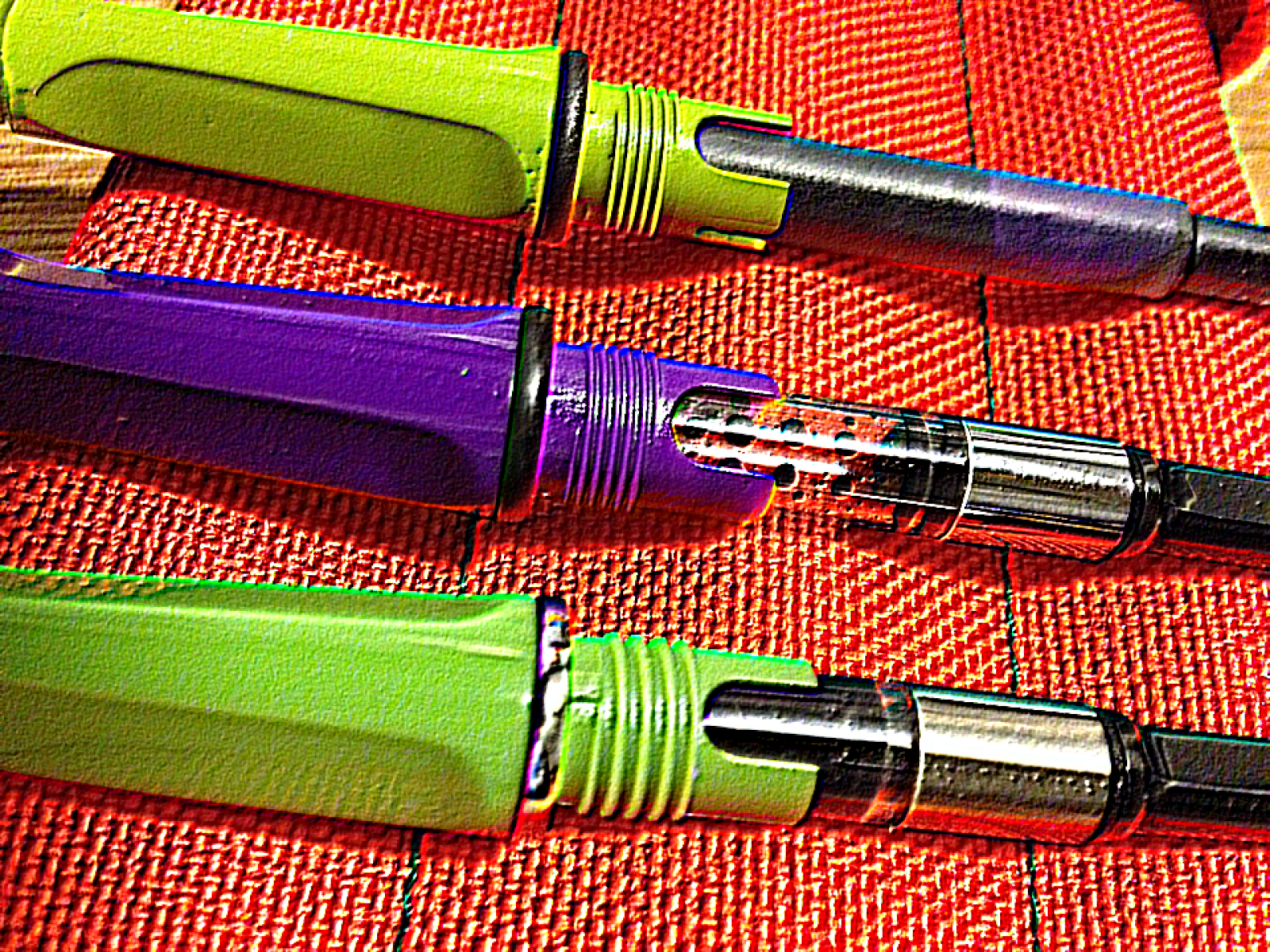
 As you can see, the threading on the Lamy and Hero is quite tight; on the Jinhao (bottom) it is further apart. I have screwed and unscrewed them a number of times to try and tell the difference but I can't. It just is.
Here it is again with a different photo effect to show it up better:
The final difference is the plastic itself. The Lamy has a more matt finish and ultimately feels higher quality than the other two (which it should given that at around $30 -which is not expensive- it's either double or thirteen times the cost of the other two!). The Jinhao and Hero are more glossy plasic. The Hero also seems a touch more flimsy and rattles a bit when screwing the base on and off. The Jinhao feels more substantial, but is still glossy and lesser quality. For me, this is an important difference regardless of price, as it's one of the things that would see me reach for the Lamy first when considering which of the pens I might want to immediately jot a note with. There is not a lot of value in owning a cheap pen if you don't use it, or if you keep deferring to the original sheep from which it has been cloned.
So, for appearance and design, the Jinhao gets the same as the Hero:
6/10
WEIGHT AND DIMENSION
To begin with, there is little if any discernible variation in the weight and length of these three pens. So that's 13.7cm long (capped) and 12.9cm uncapped; and 1cm wide.
Posted, as I mentioned earlier, the Jinhao and Lamy post deeper and well. Posted they both measure 16.5cm and balance well in the hand. The Hero posted measures 18cm long - too long.
For the Jinhao, a better rating than the Hero in this category
7/10
NIB AND PERFORMANCE
 |
| Not sure what the 18Kg stands for. It's not a gold nib, and it doesn't weigh 18KG! |
Here is an area where Jinhao is different to the other two pens. The Jinhao 599 sports what I would notionally call a "normal" nib. What I mean by that is clearer here:
 |
The Jinhao is on the far right
|
Does this make a difference for writing performance? Not really. It, again, comes down to aesthetics. I like the look of the Jinhao nib. Then again, I like the look of the Lamy/Hero too. Nevertheless, I like that the Jinhao nib is a point of difference. On a line for line comparison, the writing sample would suggest that there is really nothing to them though:

None of these pens flex. They each offer simple, comfortable writing. All wrote perfectly out of the box and have continued to do so. They are comfortable, well balanced (except the Hero when posted), and the colour variations are a lot of fun. For all the (pretensions?) of feed on the rear of the Jinhao, there is no greater or lesser ink flow or flex. It's simply a good 'muckabout' pen; that, for the price, I would be happy to ink with my Noodlers Bay State Blue.
7/10
FILLING SYSTEM
All three pens are cartridge/converters. My preference is piston always, and cheaper pens can do it (Noodlers do). Nevertheless, converters are easy to use too, and so my sleep hasn't been too irreparably damaged.
In my last comparison blog, I showed you one cosmetic difference in the converters:
 The Lamy converter has a red handle and black base; the Hero (and the Jinhao) a black handle and metal base. The Jinhao metal base is more of a matt than a chrome look.
You'll see that the Lamy (bottom) has two different arcs at the base of the section. The smaller one is to capture a separate stud that is on the Lamy converter to help the converter stay put. This extra precaution doesn't appear on either the Hero or the Jinhao; but frankly doesn't seem to make much of a difference.
7/10
COST AND VALUE
For 12 Jinhao's I paid US$2.25 each. That's close enough to the price of one Lamy or two Hero's. The Jinhao writes well out of the box. The colours are fun. The nib looks good; and the pen delivers all that it promises. Is the Lamy 12 times better? No. Is the Hero 6 times better? No. Is the Jinhao therefore value for money? YES...[UPDATE, 2017] however... I have had a number of the lids and clips of my 599s snap off or become loose and fall off; making the pen fairly useless. Is it worth a couple of bucks? Yes, but not for much more than a handy, quick-note taker.
5/10 (down from 8/10)
CONCLUSION
The Jinhao 599 plastic is an excellent copy of an already good value pen in the Safari. While the clip is a negative for me on aesthetics, the Jinhao beats the Hero by being a pen that is as comfortable to write with as the Lamy posted or unposted. Its plastics are a little cheap, issues with the clip and cap breaking or falling off are significant; but it writes well. The colours offered are bright and cheery (although I really like the Hero's purple) and it only costs between the $2.25 I paid and $5 I've seen on some web sites. A bargain.
FINAL RATING: 65/100
Legend:
00-50 = to be avoided at all costs
51-60 = If it's cheap and you don't really care...
61-70 = A nice pen with the makings of something better (just don't spend too much!)
71-80 = A better than average pen with just a few flaws that stop it from being really good.
81-90 = A good pen; a keeper. Only a few minor places off being great
91-95 = Now THIS is a pen! If you can get it, keep it, love it, cherish it, and keep it away from the dog
96-100 = GRAIL
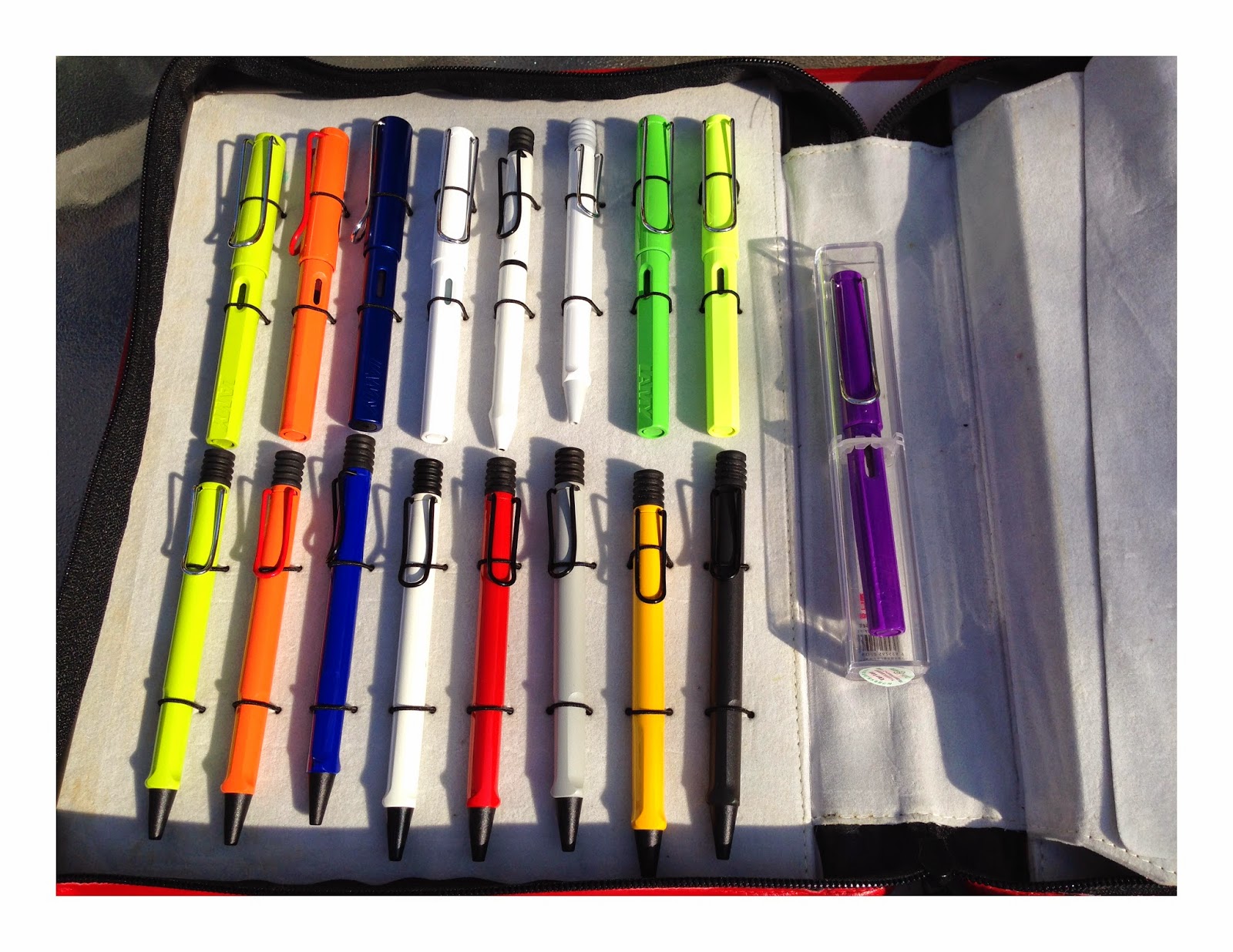 |
| Here's a few Lamy's incase you forgot where we started (the purple on the right, is the Hero) |